MythoSelf™ consequential modeling

MythoSelf™
Distinctions

How you see, hear, feel, and stand in the world shapes what becomes available to you as reality unfolds.

Thirteen distinctions. Four movements. A developmental journey toward perceptual precision, generative participation, and personal sovereignty.

Explore the distinctions

Perception · Participation · Consequence

A different way to meet reality.

MythoSelf™ consequential modeling develops a perceptual shift: a change in how you are organized to encounter yourself, other people, and the world. As that organization changes, you can recognize possibilities for action that previously went unseen.

The work follows consequence through time. An opportunity concerns what you could do now; consequence includes the trajectory that acting sets in motion. A decision matters through the actions it enables, the possibilities it closes, and the new situations those actions bring into being. Achievement becomes the capacity to choose and participate in an iterative trajectory, while remaining able to perceive, adjust, and act again.

What becomes possible, and impossible, because of how you take part?

Participation is the basis of these distinctions. You are already inside the reality you encounter, contributing through attention, expression, decisions, and action. The work develops your access to that relationship and your capacity to participate within it.

A distinction becomes useful when you can recognize it in experience. This is a teaching sequence: each distinction opens access to something that supports the next. Individuals may discover and integrate them in a different order. The four movements describe development; the professional training allocations are explained separately below.

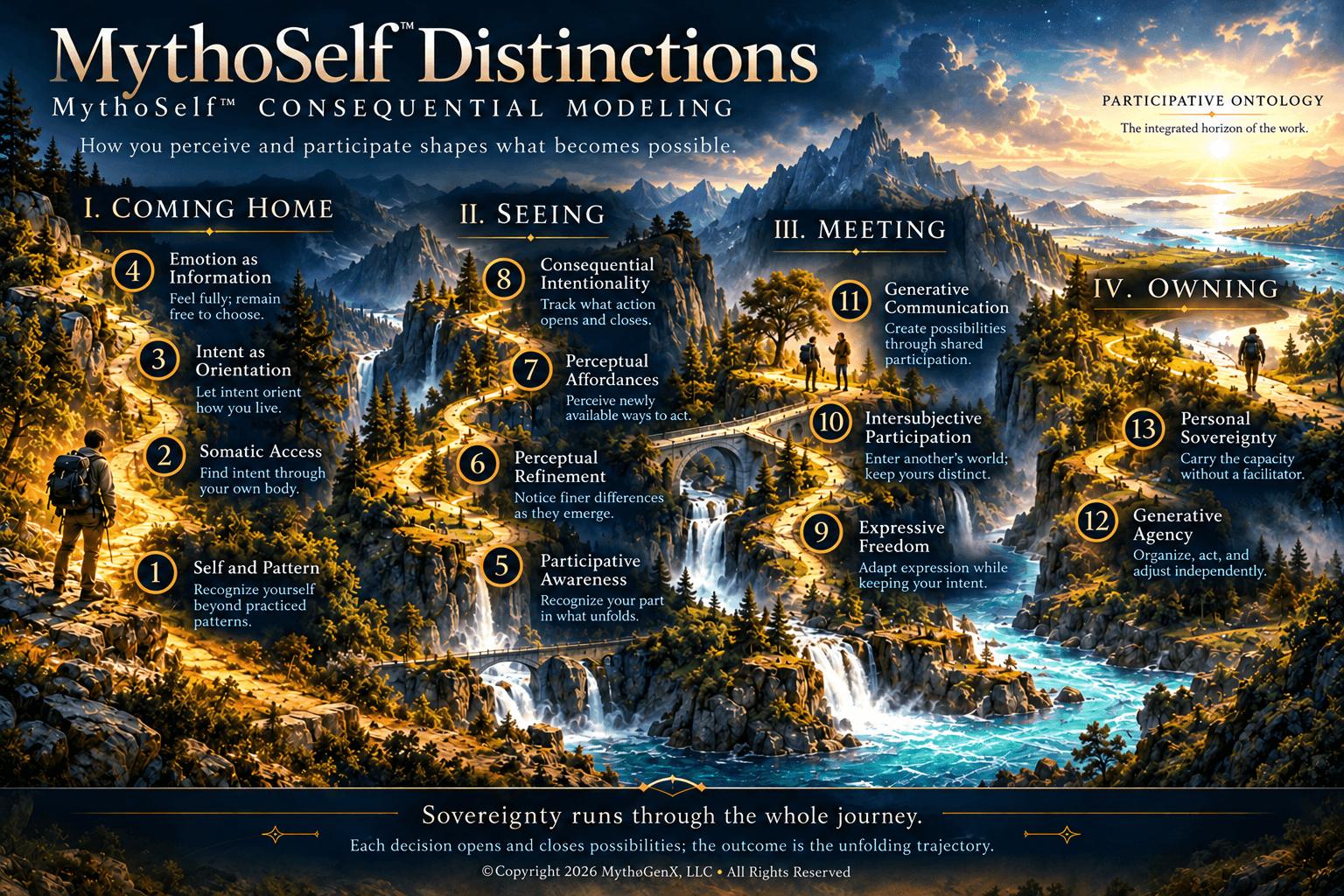
The thirteen MythoSelf™ distinctions illustrated as a journey through Coming home, Seeing, Meeting, and Owning. Sovereignty runs through the whole journey, with participative ontology on the integrated horizon. © Copyright 2026 MythøGenX, LLC • All Rights Reserved.
Select the illustration to view it at full size.

Movement I

Coming home

Recognizing yourself beyond what you have practiced.

"The workshop was for me about … 'coming home' … fulfilling a profound yearning, a longing in the space within me … the core, the center, the source from which all else manifests and flows … a place that had been familiar, that I had tasted many times … and until now, I hadn't learnt to have access to it … to function and operate from there."

Tara Bali

The journey begins with an embodied reference for being yourself. As intent becomes familiar, patterns and emotions can be experienced with greater freedom of response.

Self and Pattern

Who you are is distinct from the patterns you practiced until they felt like you.

The doorway is recognizing a familiar response without treating it as the whole of who you are. A way of reacting, protecting yourself, speaking, or holding your body may have become so well practiced that it feels inevitable. Recognizing the pattern creates room to meet the present situation differently.

In practiceNotice the difference between “that’s just who I am” and “that’s how I learned to be.”

Once identity and habit come apart, there’s room to find what was there before the habits.

Somatic Access

Recognizing GDS, GTS, and INTENT! through your own individually elicited somatic organization, and accessing them on your own.

Somatic means recognized through your lived, bodily experience. Your Generalized Desired State (GDS) is your unique experience of how you most desire to be in the world. Greater Than Self (GTS) is your unique experience of that which transcends your individual self and gives your being meaning and significance. Through their oscillation, the Third Harmonic Form of INTENT! emerges. The organization is elicited from your experience, using your own descriptors.

In practiceThe capacity develops as you recognize this orientation and re-access it independently, without needing the original facilitation sequence.

Something you can reach on purpose can become somewhere you live.

INTENT! as Orientation

INTENT! moves from a state you enter to the orientation you ordinarily operate from. The question becomes “when did I leave?”

INTENT! is a somatically recognizable organization of being around which perception, awareness, and action organize. It names an embodied orientation; particular goals are the outcomes you may pursue from it. As it becomes familiar, you begin to notice when your way of meeting a situation has changed. The work develops your capacity to recognize that departure and restore your orientation yourself.

In practiceA stable intent can remain available while circumstances, emotions, and particular aims change.

From a stable place to stand, feeling stops being dangerous.

Emotion as Information

Feeling everything fully without treating emotion or habitual response as identity, or letting it decide what you do.

Anger, sadness, fear, joy, and excitement can be fully present while you remain able to choose. Emotion becomes information to attend to within the situation. You can recognize what you feel, allow its embodied experience, and consider a response beyond the habitual one.

In practiceFreedom of response develops while feeling is present. The work does not depend on suppressing an emotion or explaining it away.

When feeling informs instead of commands, you can see your own part in what’s happening.

Movement II

Seeing

Perceiving your participation and the possibilities it opens.

Attention turns toward the relationship between how you are organized, what you can perceive, and what your actions make possible through time.

Participative Awareness

Recognizing yourself as a participant in reality, not an isolated observer of it.

Your attention, stance, words, timing, and actions are already part of the situations you encounter. Becoming aware of that participation allows you to recognize your contribution as events unfold. Other people and circumstances remain real influences; participation gives you a place to act within that shared reality.

In practiceBegin to notice what happened when you took part in a particular way, and what another way of participating might make available.

If you’re participating, the precision of your perceiving matters.

Perceptual Refinement

The sensory acuity and relational differentiation to register emerging patterns and minimal shifts.

How precisely can you see, hear, and feel what is changing? Refinement involves registering small shifts in posture, breathing, expression, voice, timing, and relationship. It also involves differentiating what you actually notice from the meaning you immediately assign to it.

In practiceIn professional practice, observations are checked against the person’s experience and the developing interaction. Precision grows through calibration and feedback.

Finer perception lets the world show more of what it offers.

Perceptual Affordances

Recognizing possibilities for action that appear when your perceptual organization changes.

An affordance is a possibility for action available in your relationship with a situation. As your organization changes, the same circumstances may reveal an opening, a useful distinction, or a way of acting that previously went unregistered. An excitatory state concerns the state you experience; excitatory perception concerns the possibilities you can actually perceive and engage.

In practiceThe relevant shift becomes evident in actionable possibilities. A more positive feeling, by itself, does not establish that perceptual change.

Seeing more possibilities raises the question of which ones your acts make real.

Consequential Intentionality

Organizing decisions and action around what becomes possible, and impossible, as consequences unfold, with intent holding steady while the outcome stays free to change.

Each decision and action changes the situation, opening some possibilities and closing others. The outcome is the unfolding trajectory itself: the possibilities your participation continues to open and close. Consequential intentionality follows that movement beyond the immediate result. You perceive, decide, act, encounter what follows, and adjust again. A particular intended result can be revised while intent continues to organize your participation.

In practiceAchievement includes the capacity to choose an iterative path of possibilities. Reaching one point matters together with what your arrival makes possible next.

Every act lands in a field shared with other people, so how you express yourself becomes part of the consequence.

Movement III

Meeting

Entering a shared world while remaining distinctly yourself.

Expression and communication become acts of participation. Through meeting others with perceptual precision, you develop the capacity to create possibilities together.

Expressive Freedom

Adapting expression and communication freely, without confusing the expression with who you are.

Language, tone, tempo, gesture, and register become instruments of participation. You can be direct, quiet, playful, precise, or spacious according to the encounter, while remaining anchored in intent. Expression becomes something you can choose and refine.

In practiceThe question is how your expression contributes to the interaction and its unfolding consequences.

Freed from guarding your identity, you can step into someone else’s world.

Intersubjective Participation

Entering another person’s perceptual organization while keeping your own intent, and keeping the two realities distinct.

You develop the capacity to recognize how a situation appears from another person’s position, using their distinctions and descriptors. At the same time, you retain your own orientation. This makes room for genuine meeting without assuming your experience and theirs are interchangeable.

In practiceIn a relationship, team, or organization, shared participation can preserve the differences that each person brings.

Two distinct people, both fully present, can produce something neither brought.

Generative Communication

Communicating with enough perceptual precision to establish shared participation, so that possibilities and outcomes emerge between people.

A conversation can change the field in which both people are participating. Through precise listening, expression, and response, a possibility may emerge that neither person proposed at the beginning. Its value comes from its relevance to the people and the situation, and from what it enables them to do.

In practiceThe work develops communication through which people can organize new possibilities together.

What can be co-created with a guide can be organized without one.

Movement IV

Owning

The capacity becomes yours to live.

Independence runs through the whole journey. These final distinctions make explicit the capacity to organize, sustain, and transfer what you have developed.

Generative Agency

Organizing perception, intent, participation, and action toward intended outcomes, independently and across domains.

You can initiate, observe what follows, and adjust your participation as circumstances develop. The capacity becomes more fully integrated when you can use it in a second domain of life, beyond the setting in which you first learned it. Agency concerns your capacity to participate and respond within reality, including influences and consequences you do not control.

In practiceThe evidence is in your independent act-and-adjust cycles. Professional assessment concerns this capacity, rather than guaranteeing a particular external result.

What you can do alone is finally yours.

Personal Sovereignty

Sustaining self-directed participation without depending on a facilitator.

The work becomes yours when you can recognize, restore, and organize your participation without someone else doing it for you. Sovereignty is the destination of this sequence and the transfer test at every level. Like a river running the whole length of the journey, it is present wherever a capability becomes independently available.

In practiceAt follow-up, the relevant capacity remains accessible with no facilitator present. Independence is considered within the scope of each experience or training.

Participation becomes a lived way of meeting reality as the distinctions integrate.

The horizon · Present from the beginning

Participative ontology

The relationship with reality was always participative. What changes is access to it, and the capacity to act from inside it.

Ontology concerns being: what it means to exist and how we understand our relationship with reality. In MythoSelf™ consequential modeling, participative ontology names a lived recognition that perceiving, choosing, communicating, and acting are ways of taking part in the world as it unfolds.

As the thirteen distinctions integrate, perception, intent, participation, and consequence can be organized together. You remain distinct from other people while participating in a shared reality. Your contribution matters alongside the actions of others, the circumstances you encounter, and consequences you cannot fully control.

Participative ontology is the integrated horizon of the journey. It is not a fourteenth module or a separate distinction to be certified. Its expression is in how you live, meet others, and participate.

How we participate shapes what becomes real.

For serious practitioners

From personal access to demonstrated capability.

The same distinctions matter differently when you experience them yourself, facilitate them with another person, or teach someone else to facilitate them. Professional development concerns what can be demonstrated reliably and transferred to the person receiving the work.

Foundations is a complete personal experience. Fundamentals develops facilitation of the foundational triad within an existing competent practice. Mytho2 and Mytho4 develop broader and advanced facilitation. Mytho8 and Mytho16 develop teaching and assessment within their defined scopes.

Explore the developmental allocation and evidence in practice

This allocation identifies where a competency is introduced and where it is assessed. It serves a different purpose from the developmental reading sequence above. Self and Pattern is the added doorway; its separate assessment allocation has not been assigned in this map.

Competency development across the professional pathway
DistinctionIntroduced or first emphasizedCompetency assessed
01 · Self and PatternThe doorway to the sequenceNo separate level assigned in this map
02 · Somatic AccessFoundationsFundamentals
03 · INTENT! as OrientationFundamentalsMytho2
04 · Emotion as InformationMytho2Mytho2
05 · Participative AwarenessMytho2Mytho4
06 · Perceptual RefinementFundamentals · basic calibrationMytho4
07 · Perceptual AffordancesMytho4Mytho4
08 · Consequential IntentionalityMytho2 · Trajectory of IntentMytho4
09 · Expressive FreedomMytho2Mytho4
10 · Intersubjective ParticipationMytho4Mytho4
11 · Generative CommunicationMytho4Mytho4
12 · Generative AgencyMytho2 · its far edgeMytho4
13 · Personal SovereigntyPresent throughoutTransfer examined within each level’s scope

Teaching scope: Mytho8 teaches, supervises, assesses, and certifies the defined Fundamentals competency. Mytho16 develops and certifies Mytho2 facilitation competencies. These scopes do not imply authority to certify every level shown in the map.

What can be observed: the evidence concerns what a practitioner can facilitate and what becomes independently available to the client.

  • Somatic access and orientation: GDS and GTS emerge in the client’s own descriptors, with somatic shifts the client confirms. At follow-up, the client can re-access INTENT!, notice a departure from it, and restore it without assistance.
  • Emotion and participation: the client can feel fully while generating responses beyond the habitual one. Both client and practitioner can recognize their own contribution to the interaction.
  • Perception and consequence: minimal somatic and relational shifts are checked against client report or recording. The client identifies actionable possibilities and articulates what a decision opens and closes, revising an outcome while intent holds steady.
  • Expression and intersubjective work: the practitioner adapts register, tone, and tempo while staying calibrated, and describes the client’s perceptual organization in terms the client confirms.
  • Generative communication: a relevant possibility emerges that neither party proposed at the start. Its development can be traced through the interaction, and the client experiences it as continuous with where they began.
  • Agency and sovereignty: at follow-up, the client organizes independent act-and-adjust cycles. Use in another domain provides evidence of transfer. Assessment concerns the capacity, rather than a promised external result.

Independence is examined throughout, within the scope of each experience or training. Foundations does not confer professional certification. Specific program requirements and credential scopes are described separately.

Explore the certification pathway →

An invitation to experience

Begin where the distinction matters to you.

You may be drawn to a different relationship with your own life, to more precise participation with others, or to developing professional capability. A first experience can be complete in itself. Further training can be explored when the next distinction matters.